Mikel Merino Took a Messi Shot to the Face. Spain Won the World Cup Anyway.
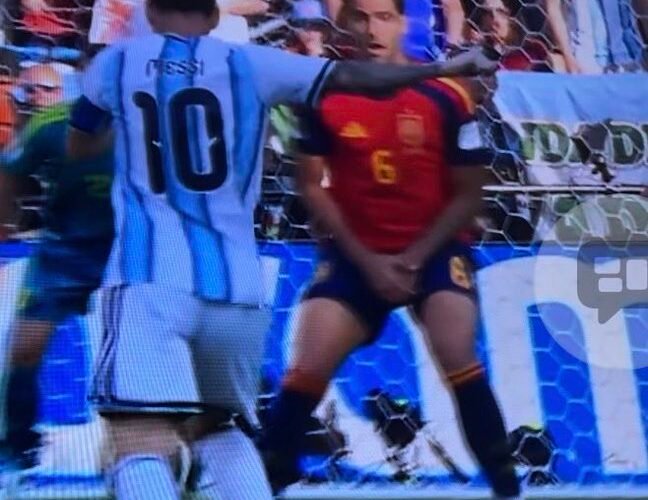
He came on to score the goal that mattered. He ended up stopping one with his face instead.
Mikel Merino has spent this tournament as Spain’s most reliable closer — the man Luis de la Fuente turns to when the game hasn’t yet been won and someone needs to make something happen. Late winner against Portugal in the round of 16. Late winner against Belgium in the quarters. Every time, the number 6, arriving in the box like he’d planned it days in advance. Sunday’s final against Argentina was supposed to follow the same script.
It didn’t. And Spain won the World Cup anyway.
What Argentina’s First Shot of the Match Looked Like
Merino came on in the 75th minute, with the game still goalless and Spain having accumulated 12 shots to Argentina’s none. He nearly headed Spain in front shortly after. He had a goal disallowed for fouling Otamendi. Then, in the 106th minute, Ferran Torres thundered in a finish from eight yards and Spain finally had what they’d dominated the entire match without finding.
It should have been over. Instead, Argentina — down to ten men after Enzo Fernández’s second yellow in the 90th — kept coming. And in the 117th minute, Lionel Messi got the ball in a dangerous position and pulled the trigger. It was Argentina’s first shot of the match. Not their first on target. Their first attempt, period.
Merino stepped into it and the ball hit him in the face. He went down immediately and had to be helped off the pitch, leaving the field to a standing ovation from the Spanish end. Spain survived the remaining minutes. The final whistle came. World champions.
The Number That Defines How Argentina Played
Zero shots through 90 minutes. In a World Cup final, against a Spain side that conceded just one goal across the entire tournament, Argentina produced nothing in attack until the match was already effectively won. Spain had 20 shot attempts and 1.94 expected goals. Argentina finished with 0.20 xG from a handful of late desperation efforts.
Scaloni’s plan was clear from the first whistle: absorb, suffocate, survive to penalties. Emiliano Martínez was brilliant — 11 saves, a World Cup final record — but was largely being asked to stop shots, not create saves out of nothing. Spain created chances in volume. Argentina created the illusion of a plan.
The red card for Fernández, earned when he clattered into Pau Cubarsí in the 90th minute with the ball already gone, ended whatever hope remained of a comeback. From that point, Spain simply needed to convert one of the chances they’d been generating for 90 minutes, and Torres did exactly that in the second period of extra time.
Spain’s Number 6 and What This Tournament Made Him
Merino started this World Cup as a super-sub. A player who had missed months of the season with a stress fracture in his right foot, who barely made it to North America in time. He scored the winner against Portugal from the bench. He scored the winner against Belgium from the bench. De la Fuente used him the way you’d use a closing pitcher — and like a good closer, he never blew the save.
Sunday was different only in its method. He didn’t score. He intercepted, with his face, the one moment Argentina produced that could have complicated things. That counts. Sometimes winning a World Cup final looks like that.
He wore 6. He finished the tournament as Spain’s most decisive player in the knockout rounds. The irony that his final act was a defensive block rather than a goal doesn’t diminish what he did across six weeks — it just makes the story stranger and better than it had any right to be.
Messi’s Exit
Lionel Messi, 39, hinted before the tournament this would be his last World Cup. His best moment came in the fifth minute, when Julián Álvarez played him through and he sprinted for the ball, only for Unai Simón to beat him to it and clear. After that, Argentina’s lack of possession meant Messi had almost nothing to work with. He was a ghost for most of 120 minutes — not because he was poor, but because the ball never reached him.
His shot in the 117th minute, the one that hit Merino in the face, was Argentina’s first. The final image of the match is Messi standing stoic, watching Spain celebrate. It may be the last image of him at a World Cup.
Spain didn’t just win. Argentina couldn’t get out of their own half long enough to threaten them, and when they finally did, Mikel Merino was in the way.
