Ferran Torres Came Off the Bench to End Messi’s World Cup Dream
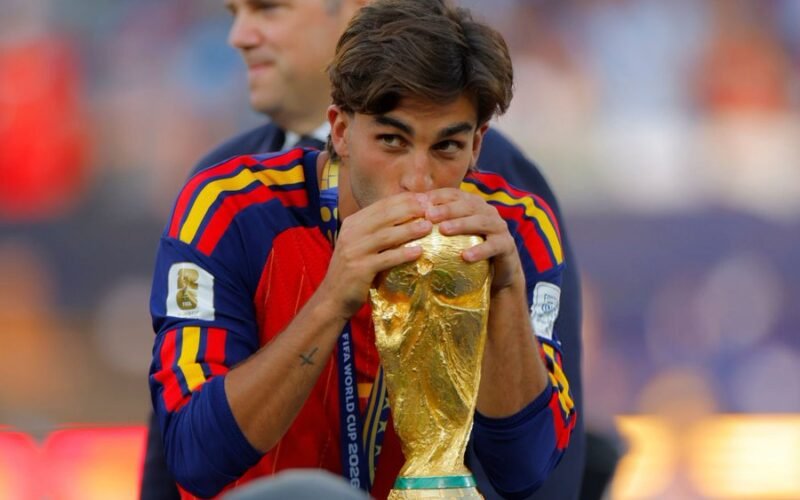
Argentina didn’t register their first shot on target until the 117th minute. By then, Ferran Torres had already won Spain the World Cup.
The final at MetLife Stadium on Sunday was not a contest of equals. Spain dominated from the first whistle — 12 shots on goal to Argentina’s zero in normal time, suffocating possession, a press that gave Lionel Messi just 15 touches to Lamine Yamal’s 26. But Emiliano Martínez was extraordinary, setting a World Cup final record with 11 saves, and Argentina clung on with the grim, practised desperation of a side that had already survived three extra-time knockout matches to get here.
Then, in the 90th minute of stoppage time, Enzo Fernández came charging through a challenge on Pau Cubarsí — the ball already gone, Cubarsí flipping in the air — and referee Slavko Vinčić showed him his second yellow. Argentina went into extra time a man down. It had been coming. Fernández had collected his first yellow in the 82nd minute for a string of unsporting fouls, and Leandro Paredes and Cristian Romero had been cautioned earlier. This was a team playing on the edge of the rules all tournament and finally falling over it at the worst possible moment.
One Goal. One Substitute. The World Cup Decided.
Torres came on in the 62nd minute for Mikel Oyarzabal, one of Luis de la Fuente’s two second-half changes alongside Pedri for Fabián Ruiz. He barely touched the ball in regulation. Then, in the opening moments of the second period of extra time — the 106th minute — Pedro Porro’s cross found Nico Williams, Williams headed it into the six-yard box, and Torres met the bouncing ball with his left foot and drove it just under the crossbar.
“I just saw the ball coming to me and I shot with the power of all the Spanish people,” Torres said afterwards on the FOX broadcast.
He is only the second substitute in history to score the winning goal in a World Cup final. He also became just the second player since 1962 to score two game-winning goals after the 87th minute in World Cup knockout matches — joining Mikel Merino, his own teammate, who had done it against Portugal and Belgium earlier in the tournament. Spain’s squad depth was not a subplot. It was the story.
What Argentina Had Left
After Torres scored, Argentina had 14 minutes to save Messi’s final World Cup. They conjured almost nothing. Giuliano Simeone’s right-footed volley from a Messi corner sailed high over the goal. A scramble late on reached the edge of the box but was deflected clear. Messi’s first genuine shot on target came in the 117th minute — nine minutes after Spain had already broken through — and it was blocked.
For a player who had scored eight goals in this tournament and had seemed to be dragging Argentina to another title through sheer force of personality, it was a hollow ending. His tournament stats — eight goals, two assists — were remarkable. His final was not. Fifteen touches in 120 minutes tells you everything about what Spain’s midfield did to Argentina’s ability to give him the ball in dangerous positions.
After the final whistle, Nahuel Molina shoved Rodri as the Spaniard ran on to celebrate. Paredes was pushing and swinging at opposition players. Scaloni rushed in to break it up. The bitterness was understandable but fitting — a team that had played on the margins of acceptable conduct throughout the tournament, exiting in the manner that approach eventually produces.
Spain’s Unfinished Record
Spain won this tournament without losing a single match. They conceded one goal in eight games — a run that started with a goalless draw against Cape Verde in the group stage before six straight wins, including a 1-0 victory over Portugal and a 2-0 semifinal dismantling of France. Under Luis de la Fuente, they are now 14 wins and one draw from 15 competitive matches.
De la Fuente becomes the oldest manager to win a World Cup. Spain become the first nation with a genuine chance of winning back-to-back World Cups in 2030, when they co-host the tournament alongside Portugal and Morocco.
Argentina, for their part, remain the last team to win consecutive World Cups — a record that has now stood since Brazil in 1958 and 1962, and that Messi and Scaloni’s side will not extend. Whether Messi plays on for Argentina remains uncertain. He hinted after 2022 that Qatar would be his last World Cup, then came back for this one. He will be 43 by the time the 2030 tournament kicks off. The arithmetic is brutal, even for him.
Torres’ goal will be replayed for decades. Martínez’s 11 saves will be remembered as the performance that somehow wasn’t enough. And Fernández’s red card — ball already gone, Cubarsí in the air — will stand as the moment the door finally closed on a champion that refused to go quietly until the very last second it had left.
